
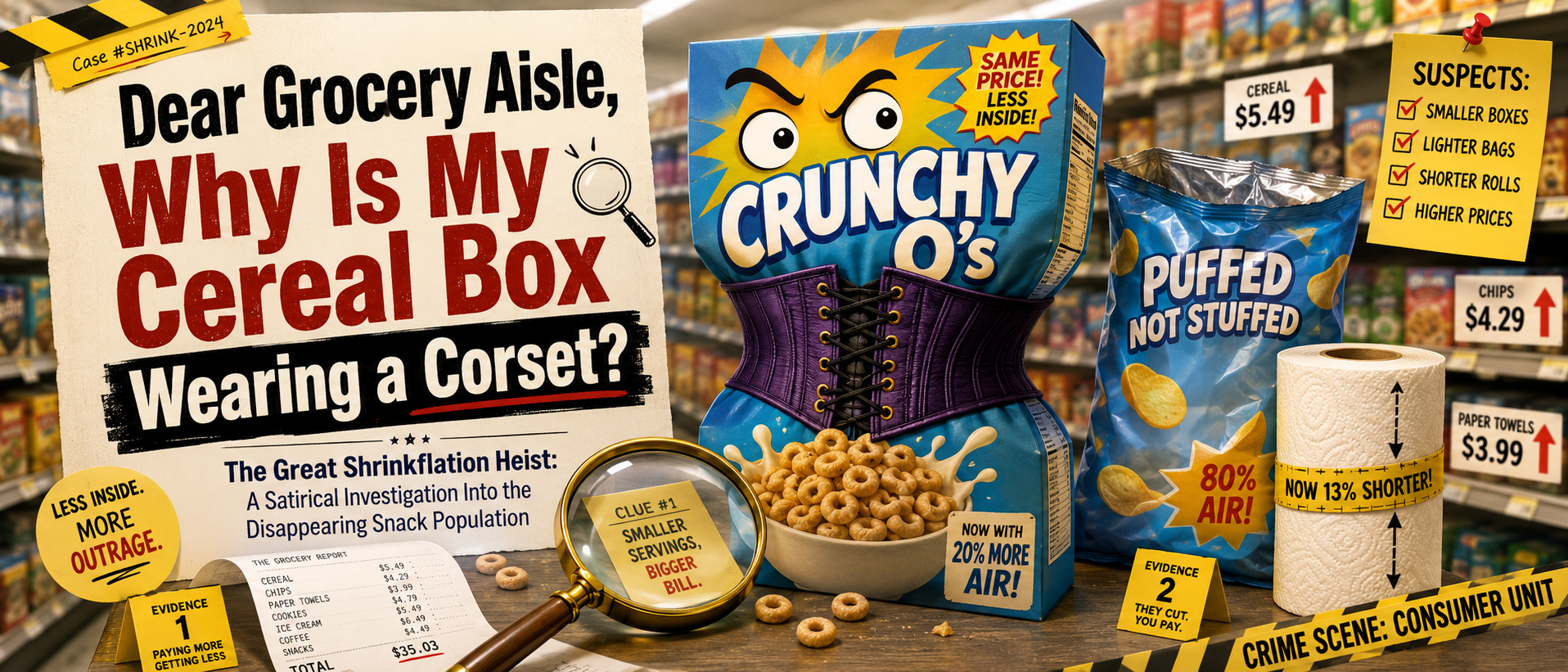
#1. Dear Grocery Aisle, Why Is My Cereal Box Wearing a Corset?
The Great Shrinkflation Heist: A Satirical Investigation Into the Disappearing Snack Population
There are mysteries in this world that keep good citizens awake at night.
Who built the pyramids?
Why do printer cartridges cost more than emotional stability?
And most importantly:
Why does my family-size bag of chips now contain enough air to resuscitate a marching band?
Ladies and gentlemen, welcome to the grand grocery illusion. The place where the box looks the same, the price looks the same, the branding still screams “value,” but the food inside has quietly slipped out the back door wearing sunglasses and a fake mustache.
They call it shrinkflation.
We call it The Snack Rapture.
And unlike some conspiracy theories that require a basement wall, twelve red strings, and a cousin named Earl who “knows a guy,” this one comes with receipts.
The Federal Trade Commission has openly warned consumers about shrinking packages, noting that brands may keep familiar packaging while putting less product inside. That means you are not imagining it. Your cookies did not go on a wellness journey. Your paper towels did not discover portion control. Your cereal did not join a monastery and take a vow of minimalism.
Exhibit A: The Package Didn’t Change. The Product Just Got Shy.
Shrinkflation is not always loud. It does not kick your door open and yell, “Surprise, peasant, enjoy four fewer ounces!”
No. It arrives quietly.
A bottle gets a narrower waist.
A box gains a dramatic cardboard shoulder pad.
A bag develops the internal air pressure of a weather balloon.
A roll of paper towels begins living a thinner, more emotionally distant life.
The Bureau of Labor Statistics tracks product size changes when calculating inflation, and it has even developed research indexes to estimate what consumer prices would look like without those size changes. Translation: this trick is common enough that the official bean counters had to create a separate bean-counting machine to count the beans that vanished.
That alone should make every shopper pause in the aisle and whisper, “So the beans have legal representation now?”
Exhibit B: The Government Knows the Snacks Are Shrinking
This is where the conspiracy gets less “lizard people in loafers” and more “corporate pricing strategy wearing a tiny monocle.”
The Government Accountability Office reviewed shrinkflation trends and found that product downsizing increased after early 2022 during the inflation surge. GAO also concluded that shrinkflation had a minimal effect on overall inflation from 2019 to 2024, but it mattered more in categories where products can easily be downsized, especially food and household goods.
So, no, shrinkflation did not single-handedly cause all inflation. That would be too dramatic, even for a cereal box with trust issues.
But in certain categories, it absolutely did its little raccoon-handed work.
GAO found that size changes contributed more noticeably to price increases in categories like cereal and household paper products, with product-size changes contributing between 1.6 and 3.0 percentage points to CPI inflation in the top downsized categories from 2019 through 2024.
Let that simmer.
Your cereal may not be the villain of the entire economy, but it has been seen near the crime scene holding a tiny shovel.
Exhibit C: The Consumer Is Expected to Do Grocery Forensics
Here is the beautiful little circus trick.
Most shoppers look at the front of the package. Companies know this. The front is where they put all the emotional jazz hands:
“Family Size!”
“Mega Pack!”
“Now With More Crunch!”
“New Look!”
That “new look” phrase deserves its own courtroom sketch artist.
Because sometimes “new look” means the brand got a graphic design refresh. Other times, it means the package has been surgically altered to smuggle fewer crackers into your pantry while maintaining eye contact.
The St. Louis Fed has explained that the BLS treats shrinkflation as a price increase in inflation calculations when size or quantity changes occur. But consumers still have to notice package-size changes themselves while shopping.
In other words, the government may count it, but you still have to catch it.
You are no longer just buying groceries. You are now an unpaid detective in Aisle 7, comparing unit prices under fluorescent lights while someone’s toddler screams beside the applesauce.
Welcome to the economy. Please bring a magnifying glass.
Exhibit D: Lawmakers Started Asking Questions
In October 2024, Senator Elizabeth Warren and Representative Madeleine Dean pressed major companies including Coca-Cola, PepsiCo, and General Mills about shrinkflation, price gouging, and tax practices. Their statement argued that reducing package size while charging the same price per ounce should not be dressed up as innovation.
Now, to be fair, corporations often point to higher labor costs, materials, transportation, packaging, supply chain disruptions, and the general chaos goblin that has been the economy since 2020.
Some of that is real.
But consumers are not wrong to ask:
If costs go up, prices rise. If costs go down, why does my cookie count still look like it survived a budget meeting with a guillotine?
The FTC also released a report on grocery supply chain disruptions in 2024, finding that large market participants accelerated and distorted the negative effects of pandemic-era supply chain disruptions.
That is the polite agency way of saying:
Some very large grocery-sector players may have turned a crisis into a buffet, then billed the public for the napkins.
The Conspiracy Theory That Isn’t Really a Theory
Let’s be careful here.
We are not saying there is a secret underground snack council meeting beneath a volcano where executives chant, “Reduce the granola by 11 percent!”
Probably.
What we are saying is much simpler:
Companies know most consumers shop by habit.
They know package design can hide quantity changes.
They know price increases make people angry faster than size decreases.
They know “same price, less product” feels less obvious than “same product, higher price.”
And they know most of us do not have time to perform a forensic audit on tortilla chips while trying to remember whether we already have laundry detergent at home.
That is not wild speculation. That is consumer behavior with a barcode.
The Shrinkflation Hall of Tricks
Here are the classic maneuvers from the Grocery Goblin Playbook:
1. The Waist Trainer Bottle
The bottle looks similar from the front, but the sides curve inward like it is preparing for a beach photoshoot.
Same shelf presence. Less product. Maximum sass.
2. The Airbag Potato Chip Bag
You open the bag and discover three chips and enough nitrogen to preserve a small museum.
The snack is now mostly atmosphere.
3. The “New Look” Disguise
“New look” often means “please admire the font while we remove 2.5 ounces from your emotional support crackers.”
4. The Sheet Count Shuffle
Paper products are masters of this. Maybe the roll has fewer sheets. Maybe the sheets are smaller. Maybe the paper is thinner. Maybe wiping now requires a logistics coordinator.
5. The Unit Price Fog Machine
The price tag screams sale, but the unit price mutters the truth from a tiny corner of the shelf label like a witness in protective custody.
But Is Shrinkflation the Main Cause of Inflation?
No.
And this matters.
GAO found shrinkflation had a minimal impact on overall inflation from 2019 through 2024 because downsized goods made up a relatively small share of the total inflation basket. Housing, services, medical care, energy, insurance, and other big expenses cannot always be shrinkflated in the same way a cereal box can.
So we should not blame every economic wound on the vanishing cookie.
But shrinkflation still matters because it is personal. It happens right in the kitchen. It happens after work, when someone opens a package and realizes the “family size” now feeds one adult, one suspicious child, and a hamster with discipline.
It is not always the biggest economic force.
It is just one of the most irritating.
Like a mosquito with an MBA.
What Consumers Can Do Without Becoming Aisle Goblins
The answer is not panic. The answer is awareness.
Start checking unit price, not just package price. Price per ounce, pound, sheet, count, or fluid ounce tells the real story.
Compare old package sizes when you can. Take pictures of items you buy often. Yes, you may look like a grocery detective. That is fine. Put on sunglasses. Commit to the role.
Buy store brands when they offer better unit value. Some private-label products are now out here doing the Lord’s pantry work while national brands perform package origami.
And most importantly: stop rewarding brands that treat your pantry like a magic trick.
Final Verdict: Guilty of Snack Sorcery
Shrinkflation is not always illegal. It is not always simple. It is not always the sole fault of greedy executives wearing gold-plated loafers and drinking sparkling water made from melted glaciers.
But it is real.
The packages are shrinking.
The receipts are talking.
The cereal box is wearing shapewear.
And the chips are mostly wind now.
So the next time you walk through the grocery store and feel like something is off, trust your instincts.
You are not crazy.
Your snacks are just being quietly repossessed by capitalism’s tiniest forklift.
And somewhere, deep in a corporate conference room, someone is pointing at a PowerPoint slide titled:
“Consumer Value Optimization Through Invisible Cracker Reduction.”
To which we say:
Dear Grocery Aisle,
We see you.
We have calculators.
And we are no longer emotionally available for your half-empty nonsense.
In closing,
Sincerely Savage